


The World Is Your Oyster
40 x 80 cm. (15.7" x 31.5")
Available · inquire for pricing · email: robert@nitiredjo.com

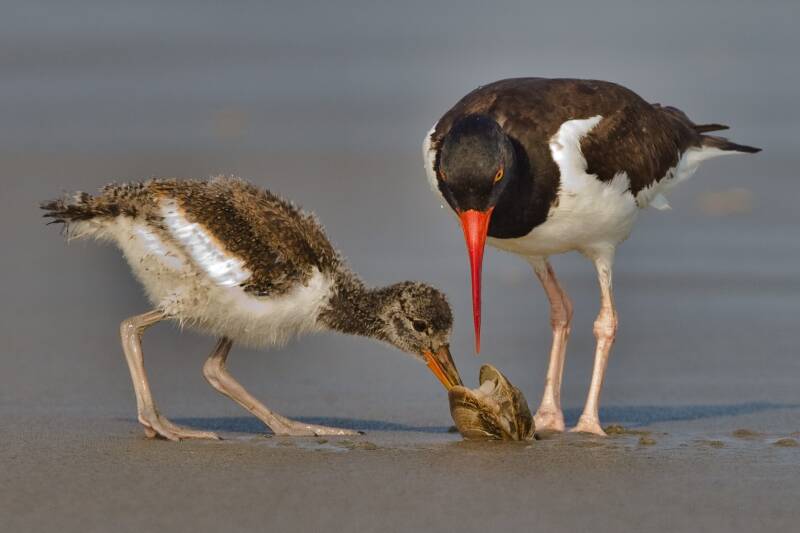
Oystercatchers are stunning looking birds. With their jet-black heads and necks, rich chocolate-brown wings, pure white bellies and of course their bright, coral-red bills, they are a true highlight of coastal birdwatching. Despite their name, they don’t actually eat many oysters. Their diet consists mostly of mussels, cockles and worms. The bird in this painting, however, is living up to its name.
Oysters are hard to open for good reason. The oyster’s shell is its only protection from hungry birds, otters, fish, and of course, people. Over millions of years, they've evolved to stay tightly closed whenever danger approaches.

But oystercatchers have exactly the right bill for the job. When watching oystercatchers, you’ll notice that individual birds have different ways of cracking the problems presented by their prey. Generally, they use two distinct strategies to open tightly sealed shells: hammering and stabbing.
A bird can choose the path of brute force, using its beak to relentlessly batter a locked shell until it breaks. It gets the job done, but at a terrible cost. It drains the bird’s energy, fills the prize with bitter shards of broken shell, and carries a dangerous risk of fracturing the bird's own beak.
But there is a second, much more elegant strategy: stabbing. Instead of fighting the shell, the bird waits patiently for the tide to shift, watching for the exact, quiet moment the oyster relaxes and opens slightly to feed. With lightning speed and perfect alignment, the bird slips its beak inside to sever the muscle. There is no wasted motion, no violence, and no damage.
This requires an absolute, hyper-focused presence. You cannot rush the tide, and you cannot blink, or the window closes.
Performing a task with such meticulous focus is very different from the way many of us approach life. We’re usually only giving things a fraction of our attention. We’re distracted, multitasking, and constantly on the move. It’s because we live in a culture obsessed with the horizon.
We are continuously chasing the next achievement, conquering circumstances and bending the future to our will. The popular phrase "the world is your oyster" is almost always used as an aggressive invitation to demand what we want from life, as if the world is a prize waiting to be violently cracked open.
But perhaps the most efficient path forward isn’t to push harder. Perhaps it’s to slow down and pay attention. That realization became this painting. In the foreground, the parent bird guides its chick through this delicate ritual of focus. The chick watches every movement, learning a lesson that goes far beyond opening an oyster.
I wanted this painting to be a visual reminder that the world does not open up through force, anxiety, or relentless chasing. True opportunity reveals itself naturally when we stop fighting the present moment.
In that stillness, the path forward becomes simple, honest, and unmistakably our own.
"The world is your oyster, not because you have the power to break it, but because you have the presence to let it open."

