

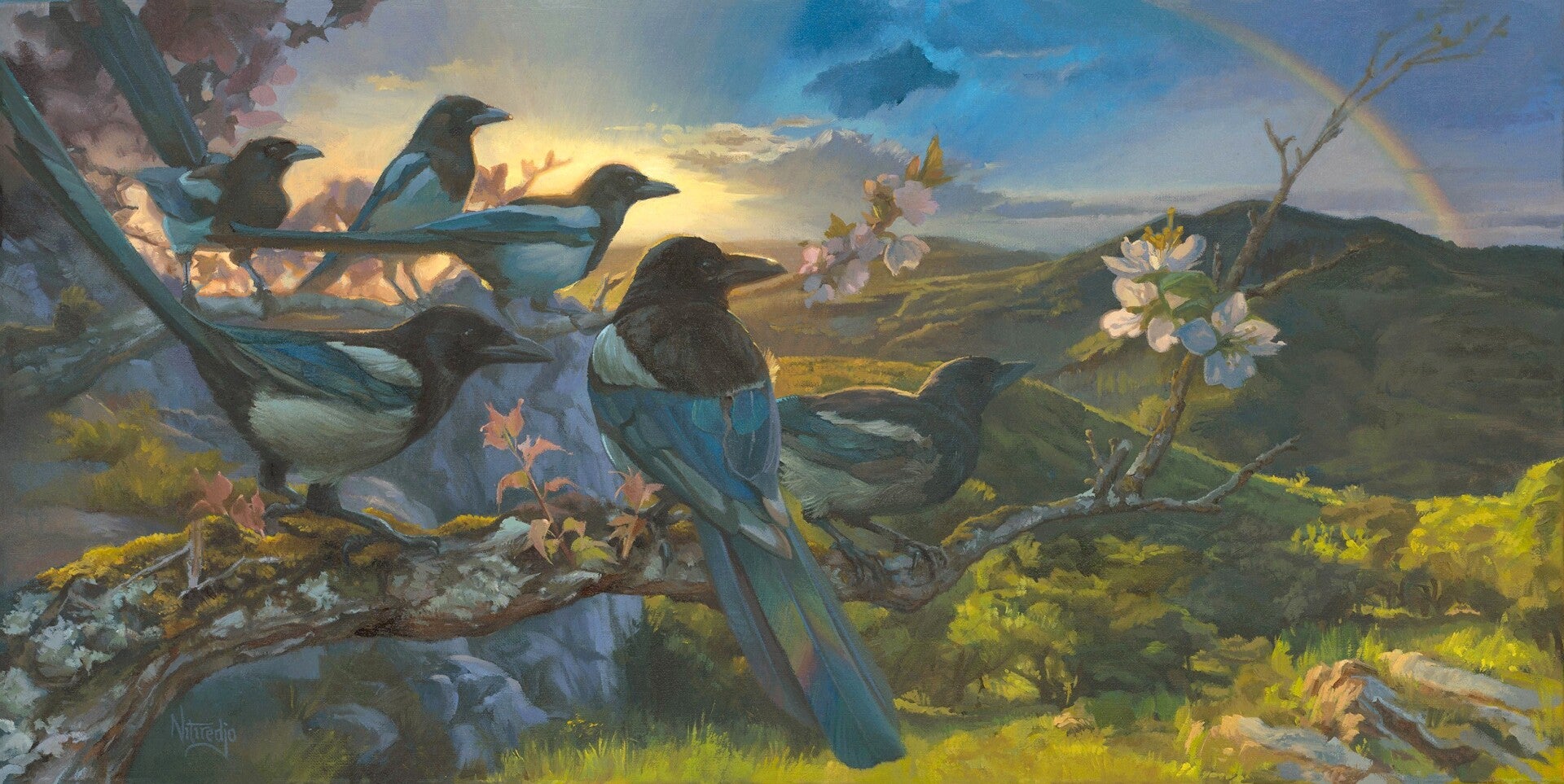
Six For Gold
40 x 80 cm. (15.7" x 31.5")
Available · inquire for pricing · email: robert@nitiredjo.com

Magpies have something of a bad reputation. Often dismissed as noisy nuisances or unwelcome thieves, they're much more than that. These birds are remarkably intelligent, capable of solving problems and adapting to their surroundings. They help keep insect populations in check, contribute to seed dispersal, and play their own part in the intricate web of life. And then there's their appearance. They may appear black and white from a distance, but in direct sunlight, their wings and tail feathers reveal an iridescent shimmer of blue, green and purple. Perhaps magpies deserve a little more appreciation than they tend to receive.
Folklore has it that magpies are fond of collecting shiny objects, particularly precious things like gold. In reality, they're far less interested in such treasures than their reputation suggests. But the magpies in this painting seem to have something valuable in mind. Gazing at a rainbow, they're going for gold, even if the precious metal in this case is metaphorical. Perhaps what draws them is not wealth itself, but the promise of something just beyond reach. Like many of us, they seem captivated by the possibility that lies on the horizon.
There's also a little Japanese influence in this painting. It's my nod to kachō-ga, a traditional Japanese art genre that literally translates as "flower-and-bird painting." It celebrates the natural world through depictions of birds, flowers, and the changing seasons. One work that inspired me is Kanō Sansetsu's Frolicking Birds in Plum and Willow Trees, a striking example of this tradition. My painting borrows something of that spirit while finding a meaning of its own.

Frolicking Birds in Plum and Willow Trees by Kanō Sansetsu, 1631. Sliding-door paintings at Myōshin-ji Temple, Kyoto, Japan. Public domain. Source: Wikimedia Commons.
The painting also draws on an old British nursery rhyme. According to the beloved verse, spotting a lone magpie is said to bring bad luck, but encountering a larger group signals fortune and abundance. This ties in nicely with the pot of gold that is said to be found at the end of a rainbow.
I’ve always liked this idea of hidden treasure waiting at the end of a rainbow. To me, that pot represents dreams, the things we deeply long for, the goals we strive to achieve. Unfortunately, people often use this idiom negatively: “Finding success as a professional artist is like chasing a pot of gold at the end of the rainbow.”
As if it’s an illusion, forever out of reach. But I refuse to be imprisoned by limiting beliefs. Anything worth achieving demands effort, but if the choice is staying trapped in negativity or daring to reach for your full potential, why not go for gold?
As an artist, I've embraced the positive side of the pot-of-gold metaphor. Success isn’t an elusive treasure; it’s the result of choosing to follow your dreams and persist through challenges. If you’ve ever made the conscious decision to pursue your passion despite obstacles, this painting is for you. Good luck on your journey. Your pot of gold is waiting.
"The pot of gold at the end of the rainbow is not an illusion. It is a reminder to keep moving toward the life you were meant to live."

