

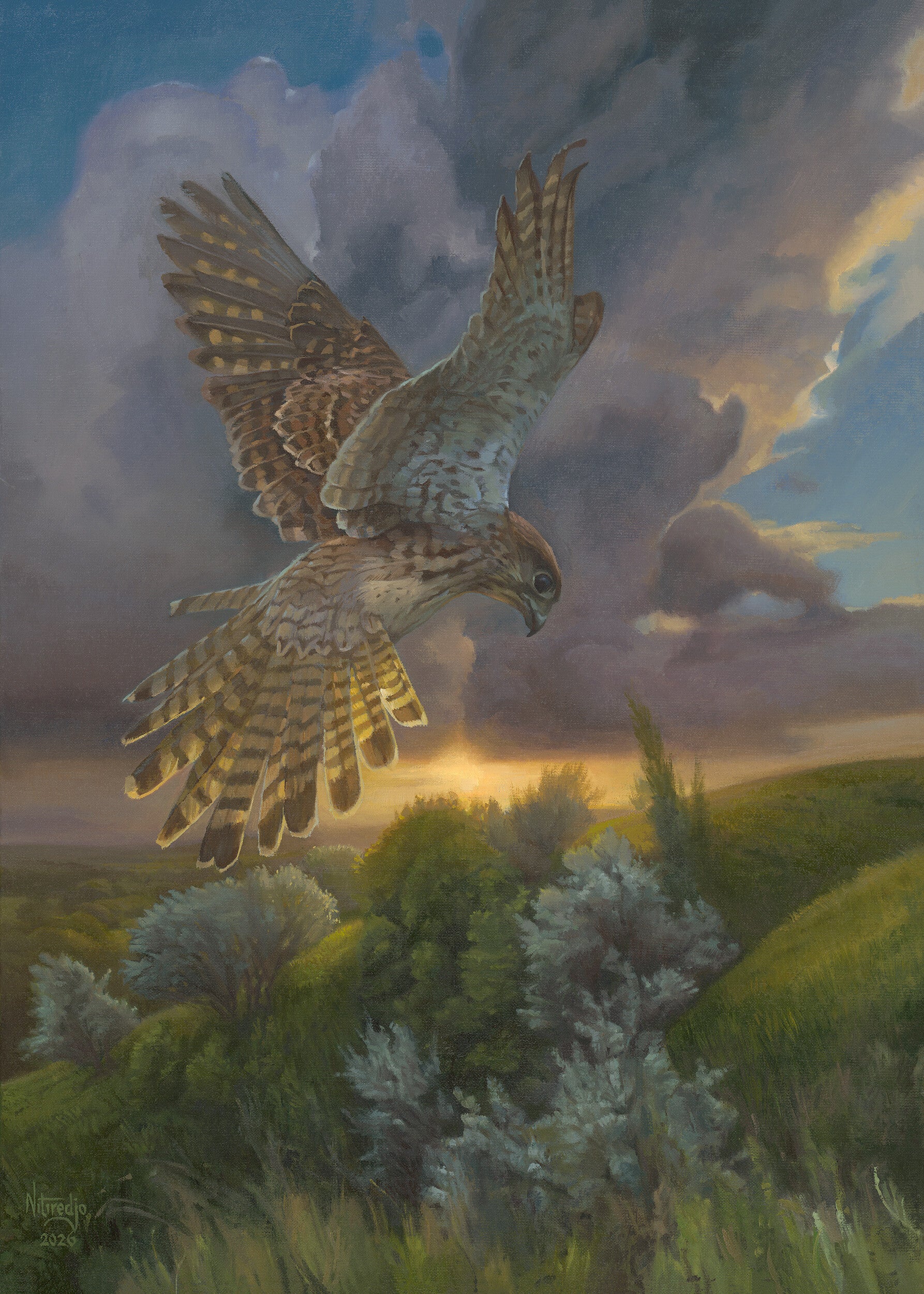
Eyes On The Prize
70 x 50 cm. (27.6" x 19.7")
Available · inquire for pricing · email: robert@nitiredjo.com

It will come as no surprise to you that besides painting, I'm also fond of birdwatching. Spending time in nature is already a great way to practise mindfulness, but trying to spot birds really forces you to slow down and anchor your attention in the present moment. It engages all your senses. You have to listen for calls, scan for movement, and remain quiet and alert. Spotting a bird is always a nice reward, of course, but even when sightings are scarce, you've still enjoyed beautiful landscapes, gotten some exercise, and given your mind a chance to quiet down.
During one of our holidays in the Vosges region of France, my wife and I went hiking up the Hohneck massif.
Luckily, we had brought our binoculars, because we saw so many kestrels that day, many of them "hover-hunting." It was remarkable to watch them at work, displaying such focus and precision.
Kestrels are among the most accomplished hovering hunters of the raptor world. When a kestrel spots potential prey, it fans its tail and adjusts its position against the wind, holding itself almost perfectly still in the air. While its body moves with the wind, the bird keeps its head and neck completely steady to lock its vision onto the ground, eyes on the prize. Rather than fighting the conditions, it works with them.

So it wasn't just an extraordinary sight to behold, there was a lesson to be learned here as well.
We often imagine that staying focused means pushing ahead with determination, refusing to let anything stand in our way. But life rarely offers ideal conditions. Plans change, distractions arise, and circumstances beyond our control can throw us off course. The answer isn't always to push harder or try to control everything around us. Sometimes, it's to find our balance, adapt to what's happening, and keep our attention on what truly matters.
This brings to mind Seijaku, a Japanese concept associated with stillness, tranquility and inner calm. In Japanese aesthetics, it describes a sense of quietness that can be found even amid movement and activity. It's not about withdrawing from the world or waiting for the storm to settle down. It's about finding stillness within ourselves, regardless of what's happening outside.
The kestrel seems to embody this idea perfectly. It doesn't resist the wind or argue with the sky. It simply accepts what's happening and works with it. Its stillness isn't passive; it's alert, deliberate and alive.
Life moves in seasons, bright days, dark days, and everything in between. The real question isn't whether challenges will come. They always do. The question is how we choose to meet them. We don't control the sky, but we do control our stance. When we cling to resistance, we drain ourselves fighting what can't be changed. When we settle into the present moment, we give ourselves room to respond instead of react.
If your peace depends on everything going right, it's not peace, it's control. Real growth begins when you learn to be steady in uncertainty.
"True calm does not come from the world around us, but from within."

